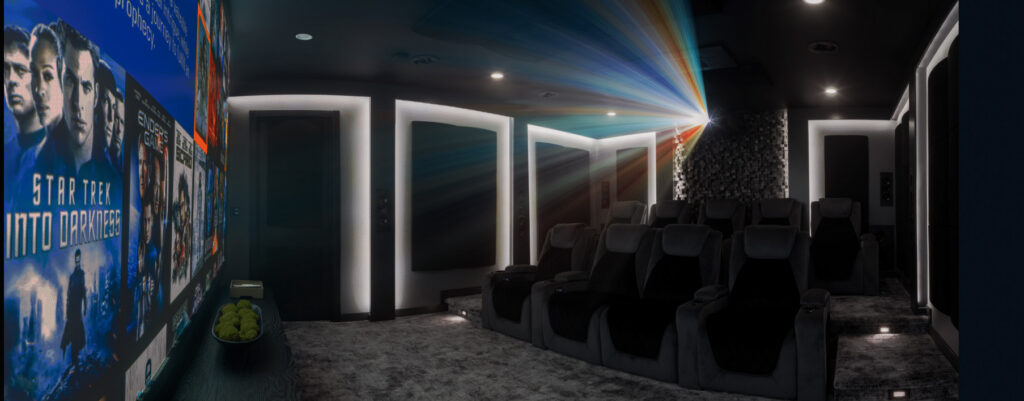
When it comes to acoustically transparent screens, you know the questions and concerns:
Will the image suffer? Will the sound be compromised? And in real-world applications… what happens when the speaker is placed closer to the screen than “recommended”
Those are valid questions.
So instead of asking you to trust “marketing” and talk about how our Harmony G3 performs in the most idyllic situations, we’ll reference independent evaluation: a recent review by Michael Hamilton at ProjectorCentral, supported by acoustic testing conducted by SH Acoustics.
First the image
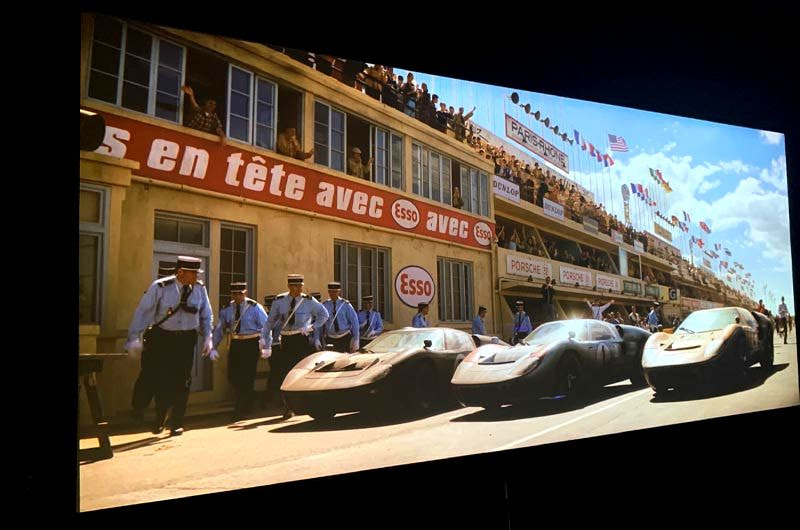
In their independent evaluation, Projector Central focused on what matters most at the high end—color accuracy, texture, and perceived resolution.
Their takeaways:
“…Stewart Filmscreen’s Harmony G3 unfailingly upholds reference-level performance, making it a compelling solution for installations where acoustic transparency and image accuracy will be held to the highest standard.”
Now: the harder question—sound
 We commissioned independent testing through SH Acoustics to measure real-world performance, including less-than-optimal installation scenarios.
Because let’s be honest—most AT screens are tested the same way. With speakers spaced and angled behind the screen to yield optimal test results.
But that’s not how real rooms work. Speakers get pushed closer to the screen.
Depth disappears. And suddenly, “acoustic transparency” becomes a question mark.
So we took a different approach.
We tested Harmony G3 in the following applications:
• 8-inch placement (ideal)
• 1-inch placement (real-world constraint)
• On-axis and off-axis configurations
• With and without liner material
Here’s what the data shows:
• Even at 1-inch speaker placement, response remains within ±3 dB across most of the audible range
• Acoustic behavior stays predictable and controlled, not erratic
• Variations like comb filtering are expected physics—and manageable with calibration
Independent listening impressions line up with the measured results after the material is installed in a room. In Projector Central’s evaluation of the Harmony G3, reviewer Michael Hamilton describes how little the screen interferes with the character of a recording. He notes:
“What I found mesmerizing was that, as the overdub, the tack piano was recorded at a different time, absent the other players, so it attacked the room solo, personifying the space, which this mix, and the Stewart Harmony G3, allows to escape.”
In other words, the same transparency indicated in the lab shows up in practice—the screen preserves spatial cues and fine detail rather than masking them.